The Skill Nobody Put on the Job Description
Here’s a confession. When I transitioned from project management to Scrum Master, I thought the job was about process. Ceremonies, artifacts, the Scrum Guide, maybe a Jira board if I was feeling fancy. I had frameworks. I had templates. I had a laminated cheat sheet.
What I didn’t have was the ability to read a room.
It took about three sprints before I realized that the hardest part of coaching had nothing to do with velocity charts or definition of done. The hardest part was sitting across from a developer who was clearly frustrated, a product owner who felt unheard, and a team that had stopped trusting each other - and knowing what to do with all of that emotional data swirling around the room.
That’s where Emotional Intelligence comes in. Daniel Goleman popularized the concept in his 1995 book Emotional Intelligence: Why It Can Matter More Than IQ, and it fundamentally reframed what “smart” means in a professional context. His argument was straightforward and backed by a growing body of neuroscience research: IQ gets you hired, but EQ determines whether you thrive. Technical skills are the entry ticket. Emotional skills are the multiplier.
Goleman built his framework on research from psychologists Peter Salovey and John Mayer, who first coined the term “emotional intelligence” in a 1990 journal article. But it was Goleman’s book - and his follow-up Working with Emotional Intelligence (1998) - that brought the concept into mainstream leadership and organizational thinking.
For agile coaches, this isn’t just interesting psychology. It’s the operating system beneath every facilitation, every difficult conversation, every moment when a team is stuck and you need to figure out why.
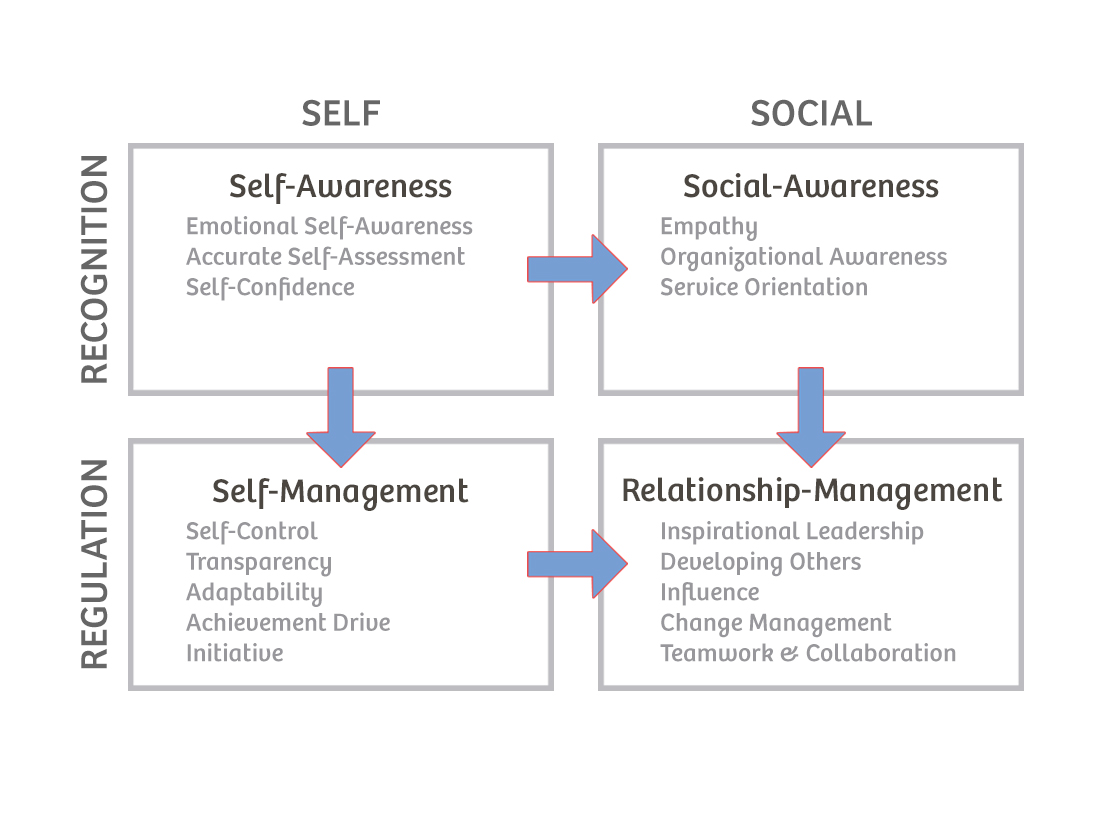
Five Components, One Compass
Goleman identified five components of emotional intelligence. They build on each other - you can’t reliably manage relationships if you can’t first manage yourself. Think of them as concentric rings, expanding outward from inner awareness to social effectiveness.
Self-Awareness
This is the foundation. Full stop. Everything else in the framework depends on it.
Self-awareness is the ability to recognize your own emotions as they happen - and to understand how those emotions influence your thoughts, decisions, and behavior. It’s knowing that you’re getting defensive before your mouth catches up to the feeling. It’s recognizing that the tightness in your chest during a tense retrospective isn’t about the retro - it’s about the conflict you had with your manager that morning.
Here’s the thing about self-awareness: most people think they have more of it than they actually do. Organizational psychologist Tasha Eurich’s research found that while 95% of people believe they’re self-aware, only about 10-15% actually are. That’s a staggering gap.
For coaches, self-awareness means understanding your default patterns under stress. Do you withdraw? Do you overcontrol? Do you make jokes to defuse tension when the tension actually needs to be felt? (That last one was me for years, by the way.)
In my classes, I teach three levels of listening. Level 1 is Internal - you’re focused on your own thoughts, your own agenda, waiting for your turn to talk. Level 2 is Focused - your attention is genuinely on the other person. Level 3 is Global - you’re reading body language, tone, what’s not being said, the energy in the room. You cannot get to Level 2 or Level 3 listening if you don’t have Level 1 self-awareness first. You have to know what’s happening inside you before you can accurately perceive what’s happening around you.
Self-Regulation
If self-awareness is noticing the emotion, self-regulation is choosing what you do with it. It’s not suppression - that’s a different thing, and it backfires reliably. Self-regulation is the capacity to experience an emotion fully without being hijacked by it.
Goleman draws on neuroscience here. The amygdala - the brain’s threat-detection center - can trigger a fight-or-flight response in milliseconds, well before the prefrontal cortex (the rational, planning part of the brain) has time to weigh in. He called this an “amygdala hijack,” and if you’ve ever sent an email you immediately regretted, you’ve experienced one.
Self-regulation is the practice of creating space between stimulus and response. Viktor Frankl’s insight applies perfectly: “Between stimulus and response there is a space. In that space is our freedom and our power to choose our response.”
For coaches, this is mission-critical. You will sit in meetings where someone says something that lands wrong. You will facilitate retrospectives where a team member attacks another. You will watch a leader undermine psychological safety in real time. Your job in those moments is not to react. It’s to respond. And the difference between those two words is self-regulation.
(I once watched a coach lose a team’s trust in about ninety seconds by visibly reacting to a stakeholder’s criticism of the team. The coach meant well - they were defending the team. But the emotional reaction signaled that the coach couldn’t hold the space. The team needed composure, not advocacy, in that moment.)
Motivation
Goleman’s version of motivation isn’t about external rewards - bonuses, promotions, or the corner office. It’s intrinsic motivation. The drive to pursue goals because they matter to you, to persist through setbacks, and to maintain optimism when things aren’t working.
This maps beautifully to what we see in high-performing agile teams. The teams that sustain velocity across quarters aren’t the ones with the best bonus structures. They’re the ones who’ve connected their daily work to something they care about. They’ve found their “why.”
For coaches, motivation is a two-sided practice. First, you need your own intrinsic drive - because coaching is a long game with lots of invisible progress and very few standing ovations. Second, you need the skill to help others find theirs. That’s less about inspirational speeches and more about asking the right questions.
This is where the GROW model enters the picture. When I coach individuals, Goal is always the starting point - not “what does the sprint goal say?” but “what matters to you about this work?” That connection between daily tasks and personal purpose is the engine of intrinsic motivation. Without it, you’re just managing a backlog.
Empathy
Empathy is the pivot point in Goleman’s framework - the bridge between managing yourself and navigating relationships with others. It’s the ability to sense what other people are feeling, to understand their perspective, and to take an active interest in their concerns.
This is not sympathy. Sympathy says “I feel sorry for you.” Empathy says “I understand what you’re experiencing.” That distinction matters enormously in coaching, because sympathy creates distance while empathy creates connection.
Goleman describes three types of empathy: cognitive empathy (understanding someone’s perspective intellectually), emotional empathy (feeling what they feel), and empathic concern (being moved to help). Coaches need all three, but cognitive empathy is arguably the most underrated. You don’t have to feel the same thing as the person across from you - but you do need to understand their reality well enough to ask the question that unlocks something for them.
This connects directly to Level 3 listening. When you’re operating at Level 3, you’re picking up on what’s not being said. The developer who says “the sprint went fine” while staring at the table. The product owner who keeps redirecting conversations away from a particular feature. The team that laughs at everything because they’ve learned that humor keeps conflict at bay. Empathy is the antenna. Listening is the skill that tunes it.
(A quick aside: empathy has a dark side in coaching. It can lead to over-identification with the team, where you absorb their frustrations and lose your objectivity. Goleman’s framework helps here - self-awareness lets you notice when empathy is sliding into emotional contagion, and self-regulation lets you recalibrate.)
Social Skills
The final component is where the inner work becomes visible. Social skills - in Goleman’s framework - encompass communication, influence, conflict management, collaboration, and the ability to build and maintain relationships.
This is not about being charming at happy hour. It’s about the practical ability to navigate complex human dynamics in service of a shared goal. Can you facilitate a conversation where two people fundamentally disagree and help them find productive common ground? Can you give feedback that actually lands? Can you read the politics of an organization well enough to know whose support you need for a change initiative - and how to earn it?
For coaches, social skills are the delivery mechanism. All the self-awareness, regulation, motivation, and empathy in the world won’t help if you can’t translate that internal intelligence into effective action in the room.
I teach the Thomas-Kilmann Conflict Mode Instrument in my A-CSM classes because it gives people a concrete map of five conflict styles: competing, collaborating, compromising, avoiding, and accommodating. Most people have a default style they reach for instinctively. The EQ move is knowing your default, recognizing when it fits the situation, and having the range to shift when it doesn’t. A coach who only collaborates will exhaust people in situations that just need a quick decision. A coach who only avoids will let tension fester until it poisons the team.
Social skills, in Goleman’s model, are not a personality trait you either have or don’t. They’re learnable, practicable skills. That’s the most empowering thing about the entire framework - none of this is fixed at birth. Every component can be developed with deliberate practice.
The Coaching Connection Most People Miss
There’s a reason emotional intelligence shows up in the Coach’s Toolkit deck rather than, say, the practices deck. It’s not a ceremony. It’s not a process. It’s the substrate that determines whether your ceremonies and processes actually work.
I say this in nearly every class: coaching is about listening and helping people find their own solutions through powerful questions, while mentoring is more directive. That distinction sounds simple. It is genuinely hard to practice. And the difficulty is almost entirely emotional.
When someone brings you a problem, the mentoring instinct fires immediately. You see the answer (or think you do). You want to share it. That impulse isn’t bad - it comes from caring. But coaching requires you to sit with the discomfort of not giving the answer, to trust the other person’s capacity to find it, and to ask the question that opens the door without pushing them through it.
That sequence - noticing the impulse (self-awareness), not acting on it (self-regulation), staying committed to their growth (motivation), understanding where they actually are (empathy), and asking the right question in the right way (social skills) - is Goleman’s five components in a single coaching interaction. The whole framework, playing out in sixty seconds.
Where EQ Meets Conflict
Every team has conflict. Healthy teams have productive conflict - disagreeing about ideas because they care about the outcome. Unhealthy teams have either destructive conflict (personal attacks, blame, defensiveness) or artificial harmony (silence, compliance, conflict avoidance masquerading as agreement).
An emotionally intelligent coach can tell the difference. More importantly, they can intervene appropriately.
When I teach conflict in A-CSM, I emphasize self-awareness about your own conflict style before trying to coach anyone else’s. If you don’t know your Thomas-Kilmann default, you’ll unconsciously project it onto the team. A coach who defaults to avoiding will interpret healthy debate as a problem to solve. A coach who defaults to competing will push for resolution before the team has fully explored the disagreement.
Goleman’s research supports this: leaders with higher emotional intelligence don’t avoid conflict - they engage with it more skillfully. They can hold tension without needing to resolve it prematurely. That’s emotional regulation in service of social skill.
Why Scrum Masters Need This More Than Anyone
The Scrum Master role is structurally unusual. You have responsibility for team effectiveness but no positional authority. You can’t mandate behavior. You can’t pull rank - because you don’t have rank.
That means your entire toolkit is relational. Influence, not authority. Questions, not directives. Modeling the behavior you want to see, not requiring it. Every single one of those capabilities is an EQ skill.
I’ve watched technically brilliant Scrum Masters fail because they couldn’t read the room. And I’ve watched quieter, less flashy Scrum Masters build extraordinary teams because they had the emotional radar to notice what mattered and the relational skill to act on it.
The Scrum Guide says the Scrum Master serves the team. Serving requires understanding what people need - not what you think they should need. That’s empathy. The Guide says the Scrum Master causes the removal of impediments. Some impediments are technical. A surprising number are emotional - fear of failure, distrust of leadership, interpersonal friction that nobody wants to name. You can’t remove an impediment you can’t see. And the emotional ones are invisible unless you have the EQ to detect them.
What It Looks Like in the Room
Nadia had been a Scrum Master at a fintech startup for about eight months when the reorg happened. Two previously independent teams - one building the consumer-facing payments app, the other handling the merchant onboarding platform - were merged into a single team of nine. The rationale was efficiency. The result was friction.
The payments team had a fast, informal culture. Standups were seven minutes. Decisions happened in Slack threads. They shipped multiple times a day and fixed forward. The merchant team was more methodical - careful code reviews, detailed acceptance criteria, a deployment cadence that was weekly at most. Neither approach was wrong. But putting them in the same room created an immediate culture clash that nobody in leadership had anticipated.
By sprint two, the standups had become tense. Ravi, one of the payments engineers, kept pushing for faster deploys. “We’re slowing down for no reason,” he said in the retro, not quite looking at anyone on the merchant side. Deepa, the merchant team’s tech lead, responded with studied calm: “We’re slowing down because we don’t want to break things for businesses that depend on us.” The room went quiet in a way that meant everybody had an opinion and nobody wanted to be the one to say it.
Nadia noticed what was happening beneath the words. Ravi wasn’t just frustrated about deployment speed - he felt like the merger had devalued his team’s way of working. Deepa wasn’t just advocating for caution - she felt defensive, as if her team’s standards were being framed as the problem. The technical disagreement was real, but the emotional undercurrent was driving it.
This is what Level 3 listening looks like in practice. Not just hearing the words, but sensing the meaning beneath them.
Nadia didn’t try to resolve it in the retro. That would have been premature - pushing for a solution before the team had actually surfaced the real issue. Instead, she asked a question: “It sounds like we have two different approaches that both worked well for their original context. Before we decide what this team’s approach should be, can we talk about what each approach was optimized for?”
That reframe changed the conversation. It moved from “whose way is right” to “what were the conditions that made each approach successful.” Ravi talked about the consumer app’s tolerance for quick rollbacks and feature flags. Deepa described the merchant platform’s contractual SLAs and the consequences of downtime for small businesses processing payments.
By the end of that conversation, the technical disagreement hadn’t been resolved - but something more important had happened. Both sides felt understood. The emotional temperature in the room dropped noticeably.
Over the following two sprints, Nadia used one-on-ones to go deeper. With Ravi, she used a GROW model conversation. “What’s the goal for you in how this team works together?” He said he wanted to feel like the merge hadn’t been a demotion. That was the real thing. It had nothing to do with CI/CD pipelines. With Deepa, a similar conversation revealed that she was worried her team members would be seen as “the slow ones” and gradually pushed out.
Armed with those insights - gained through empathy, not surveillance - Nadia facilitated a team working agreement session. She structured the conversation so that both subcultures had space to contribute, and she asked questions that surfaced shared values without forcing premature consensus. The team landed on a tiered deployment model: consumer-facing features could ship continuously with feature flags, while merchant-impacting changes went through an additional review gate. Not because one team won, but because the technical context genuinely warranted different approaches.
At the retrospective after that sprint, Yoshi - a quiet backend engineer who rarely spoke up - said something that stuck with Nadia: “This is the first time I’ve felt like we’re actually one team and not two teams pretending.”
What Nadia did wasn’t complicated. She didn’t deploy a fancy framework or run a team-building workshop with trust falls. She paid attention. She regulated her own impulse to fix things quickly. She asked questions instead of offering solutions. She understood what people were actually feeling - not just what they were saying - and she used that understanding to create the conditions where the team could solve its own problem.
That’s emotional intelligence in coaching. Not a theory. Not a personality trait. A practice.
Developing EQ When Nobody Gave You the Manual
The best news about emotional intelligence is that it’s not fixed. Unlike IQ, which is relatively stable across adulthood, EQ is developable at any age. Goleman’s later research, particularly through the Consortium for Research on Emotional Intelligence in Organizations, confirmed that targeted development programs produce measurable, lasting improvements.
Here’s what actually works, based on both the research and what I’ve seen in practice.
Start with self-awareness rituals. Journaling after difficult conversations. Asking a trusted colleague for honest feedback on how you show up under pressure. Taking a validated EQ assessment (the EQ-i 2.0 or the Emotional and Social Competency Inventory are both solid). The goal isn’t to judge yourself - it’s to see yourself clearly.
Practice the pause. When you feel a strong emotional reaction, create a literal gap before responding. Take a breath. Take a sip of water. Say “let me think about that.” The pause is not weakness - it’s the space where self-regulation lives. (I’ve told students to take a drink of water as a tactical move in meetings. Nobody questions it, and it buys you three seconds of prefrontal cortex engagement.)
Get curious about conflict. Take the Thomas-Kilmann assessment. Learn your default conflict style. Then, the next time you’re in a disagreement, consciously try a different style. If you normally avoid, try collaborating. If you normally compete, try compromising. The discomfort you feel is the growth happening.
Listen at Level 2 for one conversation per day. Just one. Give someone your full, undivided attention. No phone. No formulating your response. Just listening. Notice how different it feels. Notice how the other person responds differently when they feel genuinely heard.
Build your empathy through exposure. Read fiction (seriously - research shows it develops cognitive empathy). Have coffee with someone from a completely different function. Empathy grows through contact with perspectives that aren’t your own.
The Long Game
Emotional intelligence isn’t a certification you earn or a box you check. It’s closer to a fitness practice - something you develop through consistent, sometimes uncomfortable effort over time. There will be days when you nail the Level 3 listening and ask the perfect question. There will be days when you get amygdala-hijacked in a meeting and say something you wish you could retrieve from the air.
Both of those days are part of the practice.
What I find most encouraging about Goleman’s framework is its core claim: the skills that matter most in leadership and coaching are learnable. You weren’t born with a fixed emotional skill set. You can get better at reading a room. You can get better at sitting with discomfort. You can get better at asking the question that changes the conversation.
And honestly? The people who are best at this stuff aren’t the ones who never struggle with it. They’re the ones who struggle, notice that they’re struggling, and adjust. Self-awareness, self-regulation, in real time. The framework, applied to itself.
That’s a pretty elegant loop, when you think about it.
Go Deeper
-
Goleman, D. (1995). Emotional Intelligence: Why It Can Matter More Than IQ. Bantam Books. The book that started the mainstream conversation. Accessible, well-researched, and still relevant.
-
Goleman, D. (1998). Working with Emotional Intelligence. Bantam Books. The follow-up that applies the framework specifically to professional contexts. More directly useful for coaches.
-
Goleman, D., Boyatzis, R., & McKee, A. (2002). Primal Leadership: Realizing the Power of Emotional Intelligence. Harvard Business Review Press. Extends the EQ framework into leadership styles and organizational climate.
-
Salovey, P. & Mayer, J.D. (1990). “Emotional Intelligence.” Imagination, Cognition and Personality, 9(3), 185-211. The original academic paper that defined the concept before Goleman popularized it.
-
Eurich, T. (2017). Insight: The Surprising Truth About How Others See Us, How We See Ourselves, and Why the Answers Matter More Than We Think. Crown Business. Excellent companion reading on the self-awareness gap.
-
Consortium for Research on Emotional Intelligence in Organizations. eiconsortium.org. Research, guidelines, and EI assessment resources.
The Emotional Intelligence framework was developed and popularized by Daniel Goleman, building on research by Peter Salovey and John Mayer. Reference to their work does not imply endorsement. Goleman’s books are published by Bantam Books.