The TED Talk That Launched a Thousand Mission Statements
I was sitting in a hotel conference room in 2012, watching a facilitator play a YouTube video for sixty agile coaches. Simon Sinek appeared on screen. The red TED circle. The gold marker. The three concentric rings on the flip chart. Eighteen minutes later, every table group was rewriting their company’s purpose statement on butcher paper, and I remember thinking - this is either going to change how these people lead, or it’s going to become the most well-intentioned wallpaper in corporate history.
It became both, honestly.
Sinek’s “How Great Leaders Inspire Action” TED talk, recorded in 2009, has been viewed over 60 million times. His book Start With Why followed in 2011 and became one of those titles you see on every leadership bookshelf between Good to Great and whatever Patrick Lencioni published that year. The core idea is elegant: most organizations communicate from the outside in - what they do, how they do it, sometimes why they do it. The ones that inspire people reverse the order. They start with why.
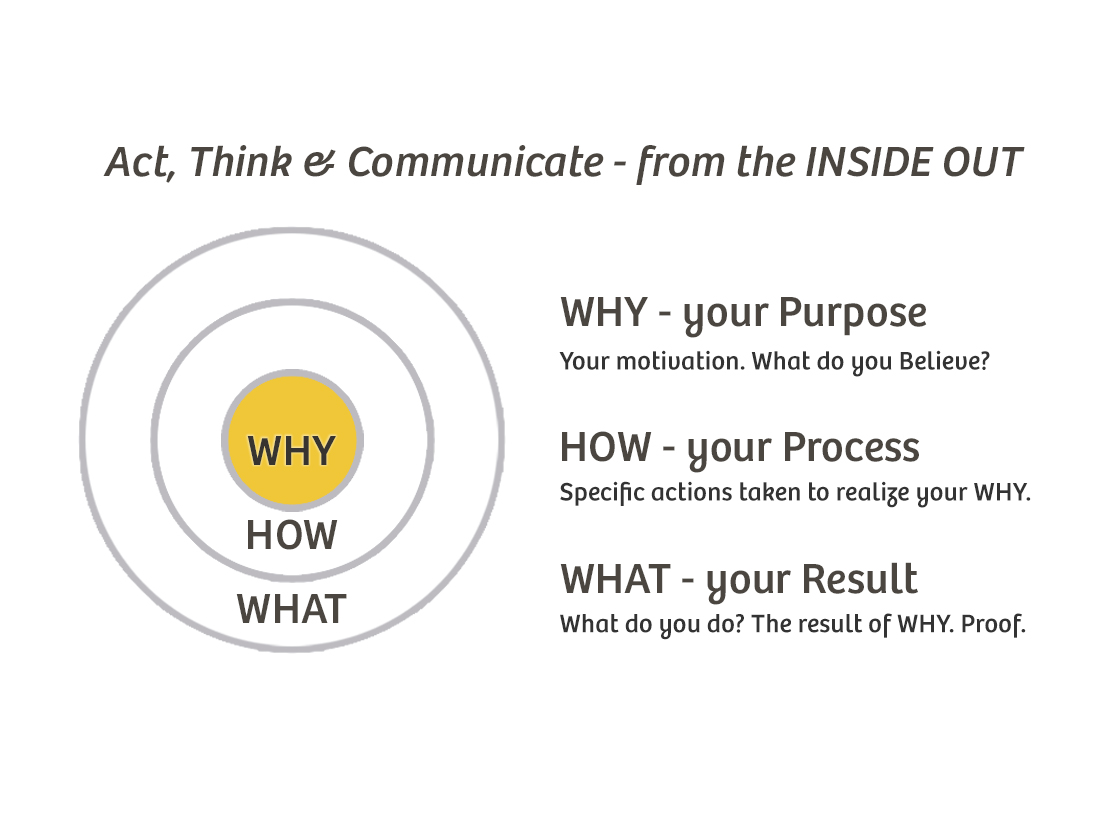
That’s the Golden Circle. Three rings. Why at the center. How in the middle. What on the outside. Simple enough to sketch on a napkin. Powerful enough to reshape how a team talks about its work - if you use it as a coaching tool rather than a poster.
Here’s the thing: the model gets a lot of criticism, some of it deserved. But in my experience coaching agile teams, it earns its keep not as a business theory but as a diagnostic question. When a team can’t articulate why they’re building what they’re building, everything downstream suffers - sprint goals, product vision, stakeholder alignment, even morale. The Golden Circle gives you a vocabulary for noticing that gap before it hollows out the work.
Three Rings, One Direction
The model is three concentric circles, read from center to edge. Every organization on the planet can tell you what they do. Most can explain how they do it. Very few can clearly articulate why they do it. And Sinek’s argument is that the why is the only part that genuinely moves people.
Let’s walk through each ring.
Why - The Center
The Why is not about making money. Money is a result. The Why is purpose, cause, or belief. It answers the question: why does this organization exist? Why does this team exist? Why should anyone care?
Sinek’s canonical example is Apple. Apple’s Why (as Sinek frames it) isn’t “we make computers.” It’s “we believe in challenging the status quo and thinking differently.” The computers, phones, and tablets are the What. The design philosophy and user-centered engineering are the How. But the Why is the reason people line up outside stores at 5 AM for a product they haven’t even held yet.
The Why is also the hardest ring to articulate honestly. Most teams, when asked why they exist, will give you a What answer dressed up in inspiring language. “We build innovative project management solutions that empower teams.” That’s a What wearing a Why costume. An honest Why sounds more like: “We believe that people do their best work when they’re not fighting their tools.” Same company, very different statement. The second one could guide decisions. The first one could be anyone.
In my classes, I run a quick exercise: I ask teams to write their sprint goal on one side of an index card and their team’s Why on the other. About seventy percent of the time, the two sides have no obvious connection. That’s not a sprint goal problem. That’s a purpose gap.
How - The Middle Ring
The How is the specific approach, process, or values that bring the Why to life. It’s your differentiating value proposition, your principles, your “this is how we operate” identity.
If the Why is “we believe people deserve financial clarity without the jargon,” the How might be “plain-language explanations, transparent fee structures, and tools that show you the full picture before you commit.” The How translates abstract purpose into concrete behavior.
For coaching purposes, the How often maps to what teams call their working agreements, engineering principles, or team norms. But here’s where teams trip up: they define How in terms of process mechanics rather than values. “We do two-week sprints with refinement on Wednesdays” is a process. “We ship small, learn fast, and never let a customer wait more than two weeks for a fix” is a How. The first describes what you do on Wednesday. The second describes who you are.
What - The Outer Ring
The What is the easiest ring. It’s the products, services, features, and deliverables. Every organization knows its What. Most can describe it in painful detail.
The What is also where teams spend almost all their communication energy. Sprint reviews become feature demos. Roadmaps become Gantt charts of deliverables. Stakeholder updates become lists of things shipped. None of this is wrong - people need to know what’s being built. But when the What is the only ring that gets airtime, work starts to feel mechanical. Teams lose the thread that connects daily tasks to something that matters.
Sinek’s model says the magic happens when you communicate from the inside out. Start with Why. Explain How. Then show What. Not because the What doesn’t matter, but because the Why is what makes people care about the What in the first place.
The Biology Claim (Handle With Care)
Sinek ties the Golden Circle to brain structure - the neocortex (rational, analytical) processes What, while the limbic system (emotions, decision-making) processes Why and How. It’s a tidy parallel and it makes for a compelling stage moment.
It’s also a simplification that neuroscientists would squint at. The limbic system is indeed involved in emotional processing and motivation, and the neocortex handles language and analytical reasoning. But the brain doesn’t actually divide its labor along three neat concentric rings. Decision-making involves both systems in complex interplay.
I mention the biology angle in my classes because it’s part of the model’s DNA, but I hold it lightly. The practical insight - that people are moved by purpose before they’re convinced by specifications - doesn’t need a neuroanatomy lesson to be useful. (Though it does make for a great conversation starter at dinner if you want everyone to slowly stop making eye contact with you.)
What This Changes About Your Coaching
The Golden Circle isn’t a facilitation exercise or a team assessment. It’s more like a lens - something you look through while coaching, not something you hand out on a worksheet. Here’s where that lens makes the most difference.
Sprint Goals That Actually Mean Something
Most sprint goals I encounter are What statements. “Complete the search filter feature and resolve the top five defects.” Accurate, measurable, and completely uninspiring. Nobody finishes that sprint goal and feels a sense of purpose fulfilled.
A Why-informed sprint goal doesn’t abandon specificity - it adds meaning. “Give our users the confidence that they can find what they need in under ten seconds” still points at the search filter, but it tells the team why the search filter matters. It changes what “done” feels like. When a developer is making a trade-off at 4 PM on a Thursday - good enough or great? - the Why version of the sprint goal actually helps them decide.
I’m not suggesting every sprint goal needs to read like a manifesto. But the exercise of asking “What’s the Why behind this sprint?” is almost always revealing. Sometimes the team discovers there isn’t one, and that’s information worth having before you plan two weeks of work around it.
Product Visions That Aren’t Feature Lists
Here’s a pattern I’ve seen maybe a hundred times: a product owner presents the “product vision” and it’s a roadmap. Features organized by quarter. Maybe some color-coding for confidence level. It answers “what are we building?” in exhaustive detail and “why should anyone care?” not at all.
The Golden Circle reframes the vision conversation. Before you map features to quarters, can you stand in front of the team and articulate why this product exists? Not what it does. Why it exists. What belief or purpose drives it. If you can’t do that in two sentences without using the word “platform,” the vision needs work.
I’ve watched product owners go through this exercise and realize they’d inherited a feature backlog but never inherited the purpose behind it. Three product owners ago, someone had a vision. By the time it filtered through two reorgs and a pivot, only the What survived. The Why got lost in Confluence somewhere.
Sprint Reviews That Connect the Dots
Sprint reviews are where the Golden Circle absence hurts most visibly. A team demos three features. Stakeholders nod. Someone asks about the timeline for the next feature. Everyone leaves.
What’s missing is the bridge between What and Why. A sprint review that starts with “Here’s why this matters to the people who use our product” before showing “Here’s what we built” transforms the dynamic. Stakeholders stop evaluating features in isolation and start evaluating progress toward purpose. The conversation shifts from “Is this feature done?” to “Are we getting closer to what we set out to do?”
Try this: at your next sprint review, open with a thirty-second reminder of the product’s Why before any demo begins. Just a sentence or two. Watch how it changes the questions stakeholders ask afterward. They stop asking “when” questions and start asking “how” questions - which means they’re engaging with the work instead of managing the timeline.
Retrospectives That Go Deeper
Retros that only address process mechanics (“We need to start refinement earlier”) stay on the outer ring. They’re useful but shallow. A retro that asks “Did we lose sight of why we’re doing this work?” opens a different kind of conversation.
I use the Golden Circle as an occasional retro prompt - maybe once a quarter, not every sprint. The question I’ll throw out is: “If someone walked into our standup tomorrow and asked ‘Why does this team exist?’ - what would you say?” The answers are sometimes confident and aligned. Sometimes they’re wildly different from person to person. And sometimes there’s a long silence, which is the most useful answer of all.
What It Looks Like in the Room
I’d been the Scrum Master on the booking engine team for about two years when I realized we had a purpose problem.
The company was mid-size travel tech. We connected boutique hotels - small independents, family-run places, converted estates - with travelers who wanted something better than the same chain lobby in every city. Good mission. The kind you can actually believe in. And my team built the engine that made it work: search, availability, booking flow, the whole pipeline. Engineering was solid. Deployments were smooth. We hit our sprint commitments more often than not. By every standard Scrum metric, we were doing fine.
The problem was that nobody seemed to care.
I’d come into this role after a stretch that had given me a pretty wide lens on what “caring about the work” could look like. I’d been a Scrum Master at a high-volume email delivery platform where every sprint felt urgent because customers were literally waiting for their messages to land. Before that, I’d done time as a TPM at a large in-flight entertainment company, working on premium cabin suites for widebody aircraft. When you’re designing the entertainment system for a fourteen-hour flight in a first-class suite, people have opinions. Stakeholders showed up. They leaned in. They argued about icon placement at 11 PM. The work had gravity.
My booking engine team had none of that gravity. Sprint reviews had become a formality. We’d demo whatever we’d built - updated search filters, a new booking confirmation flow, performance improvements to the availability calendar. Stakeholders would say “looks good” or ask about the next quarter’s features. The team would go back to their desks. I started noticing that the demos felt like homework presentations. Technically complete, emotionally flat. The kind of thing where everyone claps politely and immediately checks their phone.
I raised it in a retro. “Does anyone else feel like our sprint reviews are kind of… lifeless?”
Long pause. Then Shannon, one of our senior engineers, said something that stuck with me: “I mean, we show people what we built. What else are we supposed to do?”
That question rattled around in my head for a week. What else were we supposed to do? Shannon wasn’t being cynical. She was being honest. The team had never been shown a sprint review that did anything other than demonstrate completed work. Feature, acceptance criteria, demo, next slide. That was the format. Nobody had ever given them a reason to think it could be more.
The following Monday - and I’ll admit this felt a little embarrassing at the time, like going back to a textbook I should have already internalized - I pulled up Simon Sinek’s TED talk and watched it again. I’d first seen it years earlier at a coaching workshop. I remembered the concentric circles, the Apple example, the Wright Brothers. What I hadn’t remembered was how precisely Sinek describes the communication pattern of uninspiring organizations: they start with What, move to How, and maybe get around to Why if there’s time. I sat there watching and realized that was exactly what my team had been doing in every sprint review. Features demonstrated. Acceptance criteria met. Velocity reported. Nothing about why any of it mattered.
We were living entirely in the outer ring.
I have an MFA in Film, which means I spent years studying how stories work - how the best ones make you care about what happens before they show you what happens. Three-act structure, character motivation, the inciting incident. None of that is agile vocabulary, but it’s all purpose vocabulary. A film that opens with what the character does without establishing why they do it is just a sequence of events. And that’s exactly what our sprint reviews had become. A sequence of events. No narrative. No stakes. No reason to pay attention.
So I decided to try something for the next sprint. During planning, I asked our product owner, Anika, a question she wasn’t expecting: “Why does this sprint matter to the people who book hotels through our platform?”
Anika paused. “We’re building the saved-properties feature. So travelers can bookmark hotels they’re interested in.”
“Right, that’s the What. But why? What’s the experience we’re trying to create?”
She thought about it. Really thought about it, not just reached for the next line in the user story. “Because planning a trip to a small town in Portugal isn’t like booking a Hilton. You find this perfect little place - a converted farmhouse, maybe twelve rooms - and if you lose the link, you might never find it again. These aren’t chain hotels that show up on every search engine. They’re hidden gems. The saved-properties feature means you don’t lose the gem.”
I wrote that on the whiteboard: Don’t lose the gem.
Something shifted in the room after that. Not dramatically - nobody stood up and applauded. But the energy in planning changed. The team had been treating saved-properties as a standard CRUD feature: add to list, remove from list, sync across devices. Technically, that’s exactly what it was. But Shannon - the same engineer who’d asked “What else are we supposed to do?” in the retro - started asking different questions. “If the whole point is that these places are hard to find again, should we show the traveler how they originally discovered this hotel? Like, what search brought them here?” Grant, another engineer on the team, suggested adding a small detail about availability. Not a full calendar, just a signal that the place was still bookable. His reasoning was simple and sharp: losing the gem to a fully-booked calendar would feel worse than never finding it.
These weren’t features from the backlog. They were ideas that emerged because the team understood why the feature existed, not just what it was supposed to do. The Why unlocked design thinking from people who’d been operating as ticket-closers.
(I’ll be honest - I almost didn’t ask Anika the Why question. I was worried it would come across like I was questioning her priorities, or worse, that it would sound like one of those performative coaching moments that makes everyone’s eyes glaze over. Turns out she’d been waiting for someone to ask. She told me later that she’d known the purpose behind every feature but had never been given space in the ceremonies to share it.)
The sprint review two weeks later was different. I opened with thirty seconds of context: “This sprint, we worked on helping travelers hold onto the places they fall in love with - the small, one-of-a-kind hotels that are easy to lose in a sea of search results. Here’s what we built.” Then the team demoed the feature.
The demo itself wasn’t dramatically different. Same screen-sharing, same walkthrough of functionality. But the questions from stakeholders changed completely. Instead of “When does this go to production?” and “What’s the next feature?” we heard: “Do we know how many travelers search for the same property more than once?” and “Could we use this data to help hotels understand which travelers are most interested?” The conversation went from checklist to strategy in the span of one sprint review. It was the most engaged I’d seen those stakeholders since I’d joined the team.
Anika started opening every refinement session with what we began calling the “gem check” - a quick statement of why the next set of stories mattered to the traveler on the other end. Not every story had a compelling Why. Some were pure infrastructure. Some were compliance requirements. And that was fine. The point was never to manufacture purpose where none existed. The point was to notice when purpose was present and make sure the team felt it before they started writing code.
Over the next quarter, I noticed two changes I hadn’t expected. First, the team started pushing back on work that didn’t connect to a clear Why. Not refusing it - just asking “Can you help me understand why this matters?” before committing to it. Anika told me it made her a better product owner because it forced her to do the thinking she’d been skipping. (Her words, not mine. I would have been more diplomatic.) Second, sprint reviews stopped feeling like homework. Stakeholders started showing up who hadn’t attended in months. One of them told me, “I actually understand what your team is building now. Before, it was just feature names on a slide.”
I didn’t overhaul any processes. I didn’t introduce a new framework or change the team’s ceremonies. I didn’t run a workshop or hand out a canvas. I asked one question - “Why does this matter?” - and kept asking it until the team started asking it themselves. That was it.
That’s the Golden Circle doing what it does best. Not as a strategy model or an organizational theory, but as a coaching habit. A persistent, gentle insistence that before we talk about what we’re building and how we’re building it, we make sure we know why.
The Honest Critique (Because Every Model Has One)
The Golden Circle has been enormously influential, and it’s also been meaningfully criticized. Being honest about that matters, especially if you’re going to use it with teams.
Sinek’s flagship examples - Apple, the Wright Brothers, Martin Luther King Jr. - all share a clear, compelling Why. But critics have pointed out that this is survivorship bias at work. We’re looking at organizations and leaders who succeeded and reverse-engineering their Why as the cause of that success. For every purpose-driven company that thrived, there’s a purpose-driven company that failed, and a purely profit-driven company that succeeded spectacularly. The Why doesn’t guarantee anything.
The model also simplifies how organizations actually make decisions. Real strategy involves market analysis, competitive positioning, resource constraints, timing, and a hundred other factors that don’t fit neatly into three concentric circles. “Start with Why” is a communication framework, not a business strategy framework, and conflating the two leads to fuzzy thinking.
Here’s how I hold this in coaching: the Golden Circle is a useful prompt, not a rigorous theory. It’s great at helping teams notice when they’ve lost connection to purpose. It’s less great as an explanation of why some companies outperform others. I use it the way I use most models - as a thinking tool that opens conversations, not as a truth that closes them.
The teams I coach don’t need a perfect theory. They need someone to ask “Why are we building this?” at the right moment. The Golden Circle gives that question a framework. That’s enough.
Go Deeper
-
Sinek, S. (2009). “How Great Leaders Inspire Action.” TED Talk. The original eighteen minutes that started it all. Still worth watching, even if you’ve seen it before - Sinek is a gifted communicator and the live energy of the talk carries something the book doesn’t.
-
Sinek, S. (2011). Start With Why: How Great Leaders Inspire Everyone to Take Action. Portfolio/Penguin. The full treatment of the Golden Circle model, with extended case studies and the biological basis argument. Read it for the framework, stay skeptical about the neuroscience.
-
Pink, D. (2009). Drive: The Surprising Truth About What Motivates Us. Riverhead Books. The scientific companion to Sinek’s intuitive argument. Pink’s research on autonomy, mastery, and purpose provides empirical grounding for why the Why matters. If Sinek is the preacher, Pink is the professor - and they’re making the same sermon.
-
Sinek, S., Mead, D., & Docker, P. (2017). Find Your Why: A Practical Guide for Discovering Purpose for You and Your Team. Portfolio/Penguin. The hands-on facilitation guide. If you want to actually run a Why Discovery workshop with a team, this is the playbook. More practical than Start With Why, less inspirational.
-
Vermeulen, F. (2012). “The Problem With ‘Start With Why.’” Harvard Business Review blog. A thoughtful critique from a London Business School professor. Addresses the survivorship bias issue and the gap between inspiration and strategy. Worth reading alongside Sinek, not instead of him.