The Chart That Explains Why Your Roadmap Won’t Survive
The Stacey Matrix was one of the first cards I added to my physical coaching deck. Not because it’s complicated - it’s two axes and some labeled zones - but because it turned out to be so useful that the card kept getting borrowed. Class participants would ask to photograph it. Other trainers would slip it into their own materials “just for a session.” It was like lending a favorite book - it always left with good intentions and never quite came back. I’ve replaced that card three times now.
Here’s the situation that wore out my first copy. I was facilitating a quarterly planning session for a company that manufactured quality control products for clinical laboratory programs. Twelve initiatives on the board. The VP of Engineering wanted a single prioritization framework applied to all twelve. Same estimation approach, same governance model, same reporting cadence. “Let’s treat them all the same so we can compare apples to apples.”
The problem was that some of those initiatives were apples. And some were, I don’t know, thunderstorms. You can’t compare a well-understood data migration to a brand-new predictive quality analytics platform using the same yardstick. The Stacey Matrix gave us a way to have that conversation without it turning into a turf war.
Ralph Stacey, a professor of management at the University of Hertfordshire, developed the framework through the 1990s. His key work, Strategic Management and Organisational Dynamics (first published in 1996, now in its seventh edition), laid out a way of thinking about organizational decisions that accounts for two variables most planning frameworks quietly ignore: how much the people in the room actually agree, and how much anyone actually knows.
A quick note of intellectual honesty before we go further. The “Stacey Matrix” as you’ll find it in most agile training materials - the tidy two-axis diagram with labeled zones - is actually a simplification of Stacey’s broader work on complexity in organizations. Stacey himself has been critical of oversimplified versions. His thinking is richer and more nuanced than the diagram suggests. What I’m presenting here is the practitioner’s version - the one that’s useful in a coaching context - but I’d encourage you to read his original work if the ideas resonate. He deserves that.
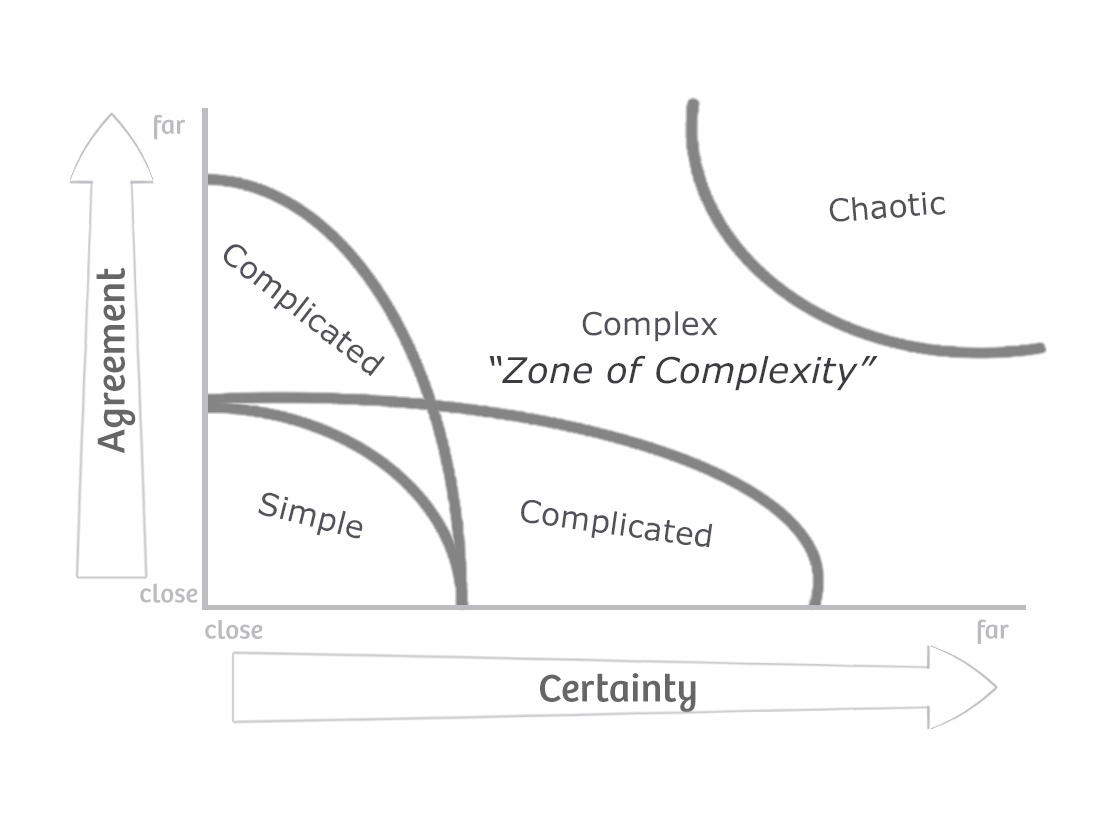
Two Axes and Five Zones
The matrix plots decisions and initiatives along two dimensions. The vertical axis represents agreement - how much alignment exists among stakeholders about what the goals are, what success looks like, and which direction to go. The horizontal axis represents certainty - how well we understand cause and effect, the technology involved, and what will happen if we take a given action.
Both axes run from high (close to the origin) to low (far from the origin). The interaction between the two creates zones, each requiring a fundamentally different leadership and management approach.
Simple (Close to Agreement, Close to Certainty)
When agreement is high and certainty is high, you’re in familiar territory. Everyone knows what needs to happen. Everyone agrees on the approach. The path from here to done is well-understood.
This is the zone of repeatable processes. Deploying a well-tested release. Running payroll. Onboarding a new team member using an established checklist. The work is defined, the steps are known, and the right move is to plan and execute. Standard project management works beautifully here. No shame in that.
The leadership approach is straightforward: delegate, monitor, and stay out of the way. Sometimes the answer is just to follow the recipe.
(This is also the zone where people get comfortable enough to believe everything is this predictable. It isn’t.)
Complicated (Moderate Agreement, Moderate Certainty)
Move away from the origin on either axis and things get more interesting. In the Complicated zone, the outcome is knowable - but it takes expertise, analysis, and negotiation to get there. There may be multiple valid approaches. Stakeholders might agree on the destination but disagree on the route.
Think of a team designing a new API integration with a partner system. The technical constraints are discoverable. The business requirements are negotiable but finite. An experienced architect can evaluate trade-offs and recommend an approach. There’s a right answer, or at least a defensible range of right answers - but it takes work to find it.
The leadership approach here is expert-driven analysis. Bring in people who know the domain. Conduct spikes and investigations. Evaluate options against criteria.
The trap is the same one Cynefin warns about: analysis paralysis. Because the problem is genuinely analyzable, teams can fall into the belief that with enough analysis, they’ll find the perfect answer. At some point you have to decide, ship, and learn from what happens.
Complex (Low Agreement or Low Certainty - or Both)
Here’s the thing about the Complex zone: this is where most of the work that actually matters lives. And it’s the zone that traditional management is least equipped for.
When certainty is low, you can’t analyze your way to the answer because not enough is known yet. When agreement is low, you can’t just pick a plan because there’s no consensus on what the plan should accomplish. When both are low, you’re in genuinely novel territory.
New product development for an unfamiliar market. Organizational change initiatives where different departments have conflicting visions of success. Technology bets where the landscape is shifting faster than your planning cycle.
The leadership approach shifts to experimentation and sense-making. Run small, safe-to-fail probes. Build prototypes. Pilot with a subset of users. Time-box your learning. Don’t try to eliminate uncertainty through planning - reduce it through action.
This is the zone where agile practices earn their philosophical keep. Sprints are probes. MVPs are probes. A/B tests, design sprints, customer interviews - all probes. The empirical process at the heart of Scrum (build, inspect, adapt) is precisely the right approach for Complex-zone work.
It’s also the zone where the most common leadership failure occurs: treating Complex work as if it were merely Complicated. “Let’s bring in a consultant to tell us the right answer.” “Let’s do a six-month analysis phase before we build anything.” These instincts feel responsible. In the Complex zone, they’re a recipe for burning months on analysis that produces confident conclusions about a system that hasn’t held still long enough to be analyzed.
The Edge of Chaos (The Zone of Innovation)
Between Complex and Chaotic, Stacey identifies a zone he calls the “edge of chaos.” This is where agreement and certainty are both quite low, but the situation hasn’t tipped into full disorder.
Here’s the counterintuitive part: this is where creativity and innovation live. When constraints are loose enough to allow novelty but not so loose that everything falls apart, the conditions for breakthrough work are at their best. The best ideas don’t come from the Simple zone where everything is predetermined, and they don’t come from the Chaotic zone where nothing is stable enough to build on. They come from this boundary - this productive tension between order and disorder.
For coaches, this matters because organizations instinctively pull away from the edge of chaos. It feels uncomfortable. It feels risky. Leaders want to move things back toward the Simple zone where outcomes are predictable and reports look clean. But if you let them, you’ll also move the work away from the zone where genuine innovation is possible.
The coaching move is to help leaders get comfortable with discomfort. Not reckless - you’re not advocating for chaos. But comfortable enough with ambiguity that the team can stay in the creative zone long enough to discover something genuinely new.
Chaotic (Far from Agreement, Far from Certainty)
When both agreement and certainty collapse, you’re in the Chaotic zone - sometimes labeled Anarchy in simplified versions of the matrix. Nobody agrees on goals. Nobody understands what’s happening. Traditional management tools don’t apply because there’s nothing stable enough to manage.
A major system outage during a product launch. A sudden regulatory change that invalidates your entire compliance approach. A team in the middle of a leadership crisis where three people think they’re in charge and nobody is actually making decisions.
The leadership approach is act to stabilize. Someone needs to make a call, impose enough order to stop the bleeding, and create the conditions to move the situation back toward Complex or Complicated where more thoughtful approaches can take over.
(This sounds authoritarian, and it kind of is. That’s okay. The mistake is staying directive after the crisis passes.)
The Zones Aren’t Boxes
One more thing worth emphasizing: the matrix is a continuum, not a set of discrete categories. A single project might have Simple-zone infrastructure work, Complicated-zone architecture decisions, Complex-zone user research, and a looming Chaotic-zone risk if the key vendor goes under.
The power of the matrix isn’t in precise categorization. It’s in recognizing that different parts of the same initiative may require fundamentally different approaches - and that applying a single management style across all of them is a guaranteed mismatch somewhere.
What This Changes About Your Coaching
Matching Governance to Reality
This is where the Stacey Matrix earns its spot in the deck.
Most organizations apply a single governance model across their entire portfolio. Every initiative gets the same stage-gate process, the same reporting template, the same estimation approach, the same review cadence. That works fine when everything in the portfolio lives in the same zone. It fails spectacularly when the portfolio spans multiple zones - which it almost always does.
The coaching move: help the organization design governance that adapts to complexity. Simple-zone work follows traditional project management with defined milestones. Complicated-zone work benefits from expert review gates. Complex-zone work needs outcome-based funding with check-ins that evaluate learning rather than progress against a predetermined plan.
This one shift - matching governance to the zone - is the single most impactful application I’ve found for the Stacey Matrix. It gives leaders permission to stop pretending that their exploratory product bet should be managed the same way as their data center migration.
Reframing Estimation Conversations
Estimation fights are one of the most exhausting patterns in agile teams. The Stacey Matrix reframes them productively.
Simple-zone work? Estimate with confidence. You’ve done this before. You know the variables. Give a number.
Complicated-zone work? Estimate with caveats. “We think this is a two-sprint effort, contingent on the spike confirming our assumptions about the partner API.”
Complex-zone work? Stop estimating deliverables and start time-boxing experiments. “We’ll spend two weeks exploring this and then decide whether to continue, pivot, or stop.” The honest answer to “how long will this take?” in the Complex zone is “I don’t know yet, and anyone who tells you they do is guessing.”
When a product owner pushes for a fixed estimate on Complex-zone work, the matrix gives you a concrete, visual way to explain why that request - while understandable - is asking the wrong question.
Having the “We Don’t All Need the Same Plan” Conversation
In my classes, I call this the “portfolio planning epiphany.” It usually hits sometime on the second day, when we’ve talked about complexity long enough for people to start mapping their real work onto the matrix.
Someone will look at their organization’s portfolio and say something like: “We’re managing our innovation pipeline the same way we manage our infrastructure upgrades. No wonder the innovation stuff keeps failing.”
That’s the insight. Not that innovation is hard - everyone knows that. But that the management approach itself is a contributing factor. When you apply Simple-zone governance (fixed scope, fixed timeline, fixed budget) to Complex-zone work (uncertain scope, emergent timeline, learning-based), you’re not just making it harder. You’re structurally preventing the conditions that Complex-zone work needs to succeed.
The Stacey Matrix makes this visible in a way that doesn’t feel like an attack on anyone’s competence. You’re not saying “your planning is bad.” You’re saying “your planning is perfectly good - for a different zone.”
The Cynefin Connection
If you’ve read the Cynefin card in this deck, you’re probably noticing some overlap. Both frameworks deal with complexity. Both argue that different situations require different approaches. Both warn against treating everything the same way.
Here’s the honest relationship. Cynefin, developed by Dave Snowden, focuses on the knowability of cause and effect. The Stacey Matrix focuses on two specific dimensions: how much people agree and how certain we are about outcomes. Cynefin gives you domains. Stacey gives you a continuous landscape mapped by two variables.
In practice, I use both. Cynefin is my go-to for explaining why a team’s problem-solving approach isn’t working. The Stacey Matrix is my go-to for portfolio-level conversations about governance and prioritization. They complement each other more than they compete.
What It Looks Like in the Room
Danielle had been a Scrum Master at a regional nonprofit for about two years - a hunger relief network that coordinated food sourcing, warehouse operations, and last-mile delivery across fourteen counties. The organization had grown fast during the pandemic and never quite caught up with its own complexity. Three software systems that didn’t talk to each other. A donor engagement platform that was technically a WordPress site with seventeen plugins and a prayer.
The quarterly portfolio review was coming up. The executive director, a former operations leader named Hector, had asked each department to submit their top initiatives for the next quarter. What landed on Danielle’s desk was a list of nine initiatives ranging from “upgrade the warehouse barcode scanners” to “build a predictive model for seasonal food demand.” Hector wanted them prioritized, estimated, and scheduled by Friday.
Danielle had learned the Stacey Matrix in her A-CSM class six months earlier and had been quietly using it for her own teams. This felt like the moment to bring it to a bigger audience.
She asked Hector for thirty minutes at the top of the portfolio review. He gave her fifteen. (Because of course he did.)
She drew the two axes on a whiteboard. Agreement on the left side running top to bottom - high to low. Certainty across the top running left to right - high to low. She labeled the zones and then handed out sticky notes.
“Write each initiative on a sticky note,” she told the room. “Then place it on the matrix based on two questions. First: how certain are we about what needs to happen and whether it will work? Second: how much agreement exists in this room about the goals and approach?”
The barcode scanner upgrade went straight to the Simple zone. Everyone agreed it was needed. The vendor had been selected. The steps were known. Hector nodded. “That one’s easy. Why are we even discussing it?”
“That’s the point,” Danielle said. “That one doesn’t need this meeting. Approve the budget, assign the project lead, and check in monthly.”
The donor engagement platform rebuild landed in Complicated. There was broad agreement that the WordPress situation was unsustainable, but the technical approach - migrate to a SaaS CRM? Build a custom integration? Hire a consultant to evaluate options? - was genuinely uncertain. Two department heads had strong opinions about different vendors. The IT lead wanted to build internally. Nobody was wrong, exactly. They just needed more information before choosing.
“This one needs a spike,” Danielle said. “Two weeks. IT evaluates the top three options against our actual requirements. We reconvene with data instead of opinions.”
The sticky note for “predictive model for seasonal food demand” was where it got interesting. The operations team had placed it in Complicated - they assumed someone with the right data science background could build the model. But when Danielle asked two questions - “Do we have the data?” and “Do we agree on what we’d do differently if the model worked?” - the room went quiet.
They didn’t have clean historical data. The data they did have was spread across three systems with different category taxonomies. And when pressed, three departments had genuinely different ideas about what a demand prediction would change. Operations wanted to optimize warehouse staffing. Programs wanted to redirect sourcing toward higher-demand items. Development wanted predictions to improve donor pitch materials.
Three different goals. No agreement. Limited certainty about whether the underlying data could support any of them.
The sticky note migrated from Complicated to Complex.
“This one doesn’t need a project plan,” Danielle said. “It needs an experiment. Pick the smallest version of one of these use cases. Spend two weeks seeing if the data even supports a useful prediction. If it does, we’ve learned something real. If it doesn’t, we’ve saved ourselves six months of building something on a foundation that doesn’t exist.”
Hector was skeptical at first. He’d spent twenty years in operations, where planning meant knowing the answer before you started. But when Danielle pointed to the matrix and said, “You’re asking me to write a project plan for something that’s sitting here” - she tapped the Complex zone - “and project plans are designed for things that sit here” - she tapped the Simple zone - “the plan won’t be wrong. It’ll be fiction.”
That got a laugh. It also got a nod.
The portfolio review ended with something the organization had never had before: different governance models for different initiatives. The barcode upgrade got a project charter with a fixed budget and a deadline. The donor platform got a structured evaluation phase with a decision gate. The demand model got a two-week learning sprint with a demo-and-decide at the end.
Two months later, Danielle ran into Hector in the break room. The barcode project was done - on time, on budget. The donor platform evaluation had surfaced a SaaS option nobody had considered that turned out to be half the cost of building internally. And the demand prediction experiment had revealed that their food category data was so inconsistent that any model built on it would be meaningless - saving them from a six-figure consulting engagement that would have produced beautiful charts built on garbage data.
“That matrix thing,” Hector said, pouring coffee. “It’s not really about the matrix, is it? It’s about admitting that we don’t know what we don’t know.”
Danielle smiled. “That’s the whole thing, Hector. That’s the whole thing.”
Go Deeper
-
Stacey, R.D. (1996). Strategic Management and Organisational Dynamics. Now in its seventh edition. The foundational text where Stacey develops the agreement-certainty model within a broader theory of complexity in organizations. Start with the latest edition for his most refined thinking.
-
Stacey, R.D. (2010). Complexity and Organizational Reality: Uncertainty and the Need to Rethink Management After the Collapse of Investment Capitalism. Stacey’s most pointed critique of traditional strategic planning and his argument for why complexity science demands a fundamentally different approach to management.
-
Zimmerman, B., Lindberg, C., & Plsek, P. (1998). Edgeware: Insights from Complexity Science for Health Care Leaders. A practitioner-friendly exploration of complexity concepts including the “edge of chaos” zone. Written for healthcare but applicable across domains. One of the best bridges between complexity theory and practical leadership.
-
Snowden, D.J. & Boone, M.E. (2007). “A Leader’s Framework for Decision Making.” Harvard Business Review, November 2007. The Cynefin article. Essential companion reading for understanding how the Stacey Matrix and Cynefin complement each other - similar territory, different lenses.
-
Olson, E.E. & Eoyang, G.H. (2001). Facilitating Organization Change: Lessons from Complexity Science. Explores how complexity-informed facilitation differs from traditional change management - directly relevant to coaches working in Stacey’s Complex and Edge of Chaos zones.