The Hardest Conversation I Ever Coached
A few years back, I was sitting in on a sprint retrospective that had gone sideways. Two developers - both talented, both convinced the other was sabotaging the codebase - had escalated past “professional disagreement” into territory that was making the rest of the team physically uncomfortable. One of them said, “You clearly don’t care about code quality.” The other fired back, “You clearly don’t care about shipping.”
I called a break. Got some coffee. And when we came back, I asked them to try something different. Instead of telling each other what the other person clearly didn’t care about, I asked each of them to describe what they’d actually observed, how it made them feel, what they needed, and what they were requesting.
The room changed. Not instantly - this isn’t a movie. But noticeably. Because it turns out that when you strip away the accusations and the mind-reading and the “you clearly” statements, most workplace conflicts are two people with legitimate needs who have no idea how to express them without sounding like they’re launching an attack.
That framework I reached for? Nonviolent Communication. Marshall Rosenberg developed it in the 1960s, drawing on Carl Rogers’ client-centered therapy and his own experiences growing up in a turbulent Detroit neighborhood. His book, Nonviolent Communication: A Language of Life, first published in 1999, has sold millions of copies and been translated into more than 30 languages. The name sounds like it belongs in a conflict-resolution seminar at the UN - and it has been used there - but I’ve found it most useful in the deeply unglamorous trenches of team dynamics, feedback sessions, and the kind of retro where somebody is about to say something they can’t take back.
Here’s the thing about NVC: the model is four steps. Four. You can teach it in ten minutes. But using it well - especially under pressure, especially when you’re the one who’s frustrated - takes real practice. It’s simple the way playing guitar is simple. Here are six strings. Good luck.
The Four Steps Everyone Nods At and Nobody Does Right
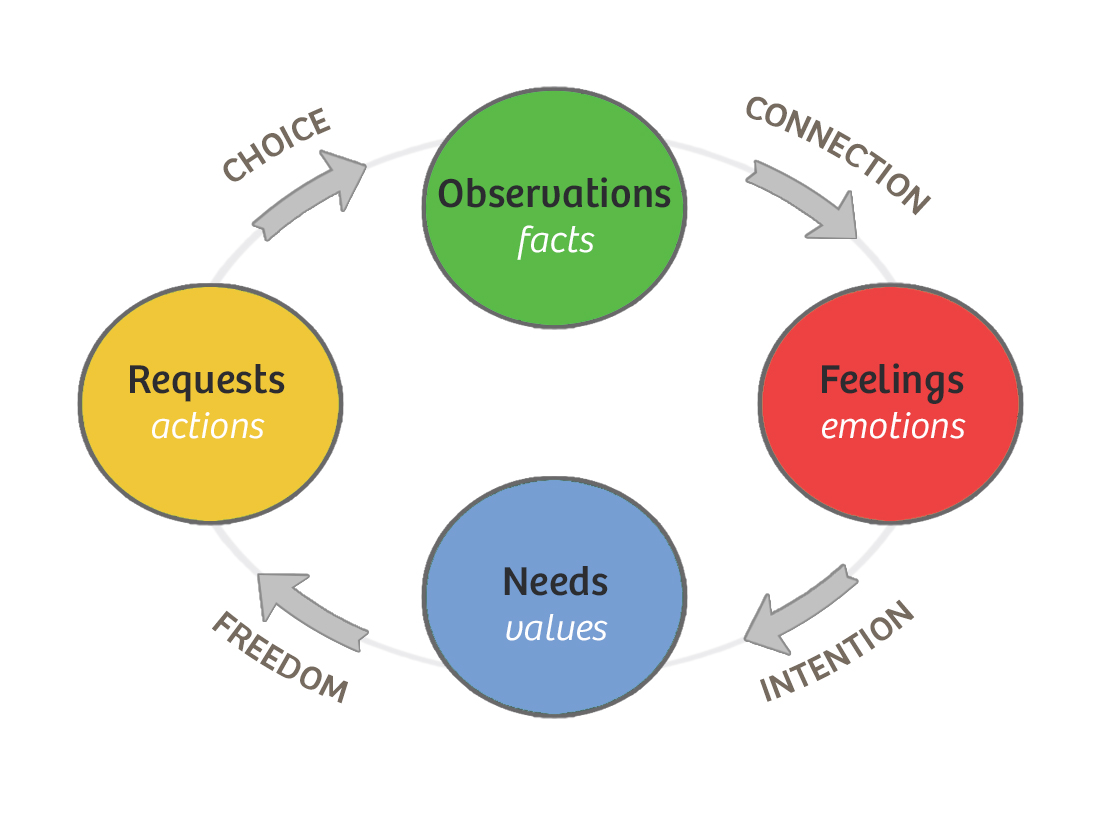
NVC has four components, designed to be used in sequence. Rosenberg was deliberate about the order - each step builds on the one before it. Skip one, and the whole thing collapses into something that sounds manipulative instead of honest.
Let’s walk through them.
Step 1: Observation - What Actually Happened
An observation is a concrete, specific description of what you saw or heard - with zero evaluation, zero interpretation, and zero judgment attached.
This is the step people think is easy. It is not easy. Our brains are wired to fuse observation and evaluation into a single statement. “You were late to standup” feels like a factual observation, but it’s already carrying judgment. Try instead: “I noticed you joined standup at 9:12 the last three days.” Same data, no verdict.
The distinction matters because the moment someone hears an evaluation disguised as a fact, their defenses go up. The conversation is over before it starts. Observation without evaluation is the foundation of everything that follows. Get this wrong, and steps two through four are just window dressing on a judgment.
Rosenberg had a specific test: could a camera record it? “You joined at 9:12” passes - a camera could confirm that. “You don’t respect the team’s time” fails. No camera captures disrespect. That’s an interpretation living inside your skull.
In my classes, I call this the “security camera test.” If a security camera in the corner of the room couldn’t have captured it, it’s not an observation. It’s a story you’re telling yourself about what happened. (And it might be a perfectly reasonable story. But it’s still a story.)
Step 2: Feeling - What’s Happening Inside You
Once you’ve described what you observed, the next step is to say how you feel about it. Not what you think about it. Not what you think the other person intended. How you, specifically, feel.
This is where it gets uncomfortable for a lot of people - especially in professional settings where feelings are treated like something you leave in the parking lot next to your lunch bag. But Rosenberg’s insight was that feelings are data. They point toward needs. And if you skip the feeling, you lose the signal.
There’s a trap here that catches almost everyone the first time. NVC distinguishes between actual feelings and what Rosenberg called “faux feelings” - thoughts disguised as feelings. “I feel disrespected” sounds like a feeling, but it’s actually an interpretation of the other person’s behavior. You’re attributing motive. Compare that to “I feel frustrated” or “I feel anxious.” Those are emotions. They live inside you. Nobody can argue with them.
The quick test: if you can replace “I feel” with “I think” and the sentence still works, it’s probably not a feeling. “I think disrespected” - yeah, that’s a thought. “I think frustrated” - nope, that’s a feeling.
(This distinction alone has saved more coaching conversations than I can count.)
Step 3: Need - The Universal Human Thing Underneath
Every feeling is connected to a need - something universal, something human, something that has nothing to do with the specific person standing in front of you. Frustration often points to a need for autonomy, or reliability, or respect. Anxiety might point to a need for clarity, or safety, or inclusion.
Rosenberg’s framework insists that needs are never about a specific person doing a specific thing. “I need you to stop interrupting me” is not a need - it’s a request with a need hiding behind it. The need might be “I need to feel heard” or “I need space to finish my thoughts.” The distinction matters because needs are universal and non-threatening. Requests directed at specific behavior can feel like demands.
This is the step that transforms the conversation. When someone says “I need predictability in our deployment process,” the room hears something very different than “You keep breaking the build.” Both might be true. But one invites collaboration and the other invites defensiveness.
In coaching contexts, the needs step is where empathy lives. When a team member expresses a need - even clumsily - and another team member actually hears it, something shifts. They stop seeing each other as obstacles and start seeing each other as humans with legitimate concerns. It sounds soft. It is soft. It also works better than anything else I’ve tried.
Step 4: Request - Say What You Want (Not What You Don’t Want)
The final step is making a clear, concrete, actionable request. Not a demand. Not a hint. Not a passive-aggressive suggestion wrapped in a question. A request.
Rosenberg was specific about what makes a request rather than a demand: the person making it has to be genuinely willing to hear “no.” If “no” isn’t an acceptable answer, it’s a demand, and the other person will sense that instantly regardless of how politely you phrase it.
Good requests are positive (what you want, not what you don’t want), specific (observable actions, not vague attitudes), and doable now (not abstract commitments about the future).
“Would you be willing to message the team channel if you’re going to be more than five minutes late to standup?” - that’s a request. It’s specific, positive, and the person can say no without the relationship imploding.
“Could you try to be more respectful of people’s time?” - that’s a wish, not a request. It’s vague, it implies the person is currently disrespectful, and there’s no way to know when they’ve fulfilled it. It also practically guarantees a defensive response, which is the opposite of what you’re going for.
Here’s the complete sequence in action: “When I see that standup starts ten minutes late three days in a row (observation), I feel frustrated (feeling) because I need predictability in how we start our day together (need). Would you be willing to send a Slack message if you’re running late, so we can decide whether to wait or start without you (request)?”
Four sentences. No accusation. No mind-reading. No “you clearly don’t care.” Just what happened, how I feel, what I need, and what I’m asking for. Dad-joke-level simple. Graduate-school-level hard to do consistently.
What This Changes About Your Coaching
NVC isn’t a team ceremony or a process artifact. It’s a lens for communication - and once you start coaching with it, you realize how much conflict is generated not by genuine disagreement but by the language people use to express themselves.
In Retrospectives
Retros are where NVC earns its keep. The standard retro prompt - “What went well, what didn’t, what should we change?” - often produces a list of grievances disguised as observations. “The PO keeps changing requirements mid-sprint” is an evaluation, not an observation. It triggers defensiveness and derails the conversation.
Try reframing retro items through NVC before discussion. Ask participants to write their items using the format: “I observed [fact]. I felt [emotion]. I need [universal need].” They don’t have to include a request yet - that’s what the group discussion produces together.
The shift is immediate. A room full of “you did X wrong” statements becomes a room full of “here’s what I experienced and what I need.” Same raw material, radically different conversation.
In Feedback and One-on-Ones
Giving feedback is the single most common context where NVC transforms outcomes. Most feedback fails because it leads with evaluation: “Your code reviews are too slow” or “You need to speak up more in refinement.”
Coach team members - and especially other Scrum Masters and managers - to structure feedback using the four steps. Observation first, always. The security camera test applies. If you can’t point to a specific moment that a camera could have recorded, you’re not ready to give the feedback yet. You need to go back and gather actual observations first.
This also works in reverse. When someone receives feedback that feels like an attack, NVC gives them a way to hear it differently. “What did you observe? How did it make you feel? What do you need from me?” Those three questions can defuse almost anything.
In Conflict Resolution
When two team members are stuck in a cycle of blame, NVC gives you a structured path out. The coach’s job is not to determine who’s right - it’s to help each person hear the other’s observations, feelings, and needs without the static of evaluation and judgment.
I’ve watched team members who hadn’t spoken civilly to each other in weeks completely reset after a 30-minute NVC-structured conversation. Not because they agreed on the technical question. They still disagreed. But they stopped attributing malice to each other’s positions, and that turned out to be enough to unblock the collaboration.
(It’s almost unfair how effective this is. Almost.)
In Building Psychological Safety
Psychological safety - the belief that you won’t be punished for speaking up - is built one interaction at a time. NVC creates the conditions for it by removing the most common punishments: judgment, blame, and dismissal.
When a team operates with NVC norms - even loosely, even imperfectly - people take more risks. They admit mistakes earlier. They ask questions they’d normally swallow. They disagree with senior people without framing it as a career-threatening act. The connection between NVC and psychological safety isn’t theoretical. It’s visible in the room, usually within a few weeks of consistent practice.
What It Looks Like in the Room
Denise had been a Scrum Master at a mid-sized state education agency for about eighteen months. Her team built internal tools for the department - nothing glamorous, but the kind of work where a bug in a data import could mean a thousand teachers got the wrong certification renewal notices.
The team was eight people, mostly seasoned government employees who’d been writing software long before “agile” showed up on their doorstep. They were competent, careful, and deeply skeptical of anything that sounded like corporate self-help. Which is exactly what NVC sounded like when Denise first mentioned it.
The immediate problem was Marcus and Terri. Marcus was a senior developer who’d been at the agency for twelve years. Terri was a business analyst who’d transferred in from the budget office six months earlier. Their working relationship had deteriorated to the point where refinement sessions felt like watching two people argue through a translator - except there was no translator, just increasingly terse Jira comments.
Marcus thought Terri’s requirements were vague and kept changing. Terri thought Marcus dismissed her questions and talked over her in meetings. Both of them had complained to Denise separately. Both of them were convinced the other person was the problem.
Denise didn’t introduce NVC as NVC. She’d learned that lesson. Instead, at the next retro, she changed the format. She handed out index cards and asked everyone to write down one thing that had been difficult in the last sprint - but with a rule. The card had to answer three questions: What specifically happened? How did it make you feel? What do you need going forward?
Marcus wrote: “In Tuesday’s refinement, the acceptance criteria for the certification import story changed three times during the meeting. I felt confused and frustrated. I need the criteria to be stable before I start building.”
Terri wrote: “When I asked clarifying questions about the data model in refinement, I was told ‘that’s already been decided’ before I could finish my question. I felt dismissed. I need space to ask questions without being shut down.”
Denise read both cards to the group - anonymously at first, though everyone could guess the authors. Then she asked: “Does anyone disagree with these observations? Not the feelings or the needs - just the facts.”
Nobody did. The acceptance criteria had changed. Marcus had cut Terri off. Those were things a camera would have captured.
Then Denise asked: “Can anyone relate to these needs? The need for stable criteria before building. The need for space to ask questions.”
Every hand went up. Every single one.
That was the turn. Marcus and Terri weren’t having a personality conflict. They had unmet needs that they’d been expressing as accusations. “You keep changing things” was Marcus’s way of saying “I need stability.” “You dismiss everything I say” was Terri’s way of saying “I need to be heard.”
Over the next few sprints, Denise worked with both of them - sometimes together, sometimes separately - on translating their frustrations into the observation-feeling-need format. It wasn’t smooth. Marcus thought it was “touchy-feely nonsense” for the first two weeks. Terri over-corrected and started prefacing every sentence with “I feel” in a way that felt performative.
But by the end of the quarter, something had genuinely changed. Refinement sessions ran shorter. Jira comments got more specific and less barbed. Marcus started asking Terri clarifying questions instead of shutting them down. Terri started writing acceptance criteria with concrete examples instead of abstract descriptions.
At the quarterly review, their manager - who had been on the verge of separating them onto different teams - asked Denise what she’d done. Denise shrugged. “I taught them to say what they actually mean. Turns out that’s harder than it sounds - and more useful than you’d think.”
Go Deeper
-
Rosenberg, M.B. (2015). Nonviolent Communication: A Language of Life, 3rd edition. PuddleDancer Press. The definitive text. Rosenberg’s voice is warm and direct - the book reads more like a conversation than an academic treatment. Start here.
-
Rosenberg, M.B. (2005). Speak Peace in a World of Conflict. PuddleDancer Press. A shorter, more focused treatment of NVC applied to organizational and social contexts.
-
Kashtan, M. & Kashtan, I. “Basics of Nonviolent Communication.” BayNVC.org. A concise primer from two of Rosenberg’s most experienced trainers. Good for sharing with teams who won’t read a full book.
-
Connor, J.M. & Killian, D. (2012). Connecting Across Differences: Finding Common Ground with Anyone, Anywhere, Anytime. PuddleDancer Press. Useful for coaches working with cross-functional teams where cultural and disciplinary differences compound communication challenges.
-
The Center for Nonviolent Communication. cnvc.org. Founded by Rosenberg. Training resources, certified trainer directory, and community of practice.
The Nonviolent Communication model was developed by Marshall B. Rosenberg, Ph.D. NVC is a registered trademark of the Center for Nonviolent Communication (cnvc.org). This article is an independent coaching reference and is not affiliated with or endorsed by CNVC.