The Meeting Where Everyone Was Right and Nothing Got Done
I once watched a team of genuinely smart people spend ninety minutes arguing about whether to rebuild their checkout flow. The product owner had data showing a 34% cart abandonment rate. One engineer kept pointing out the technical debt in the current system. Another kept asking about edge cases in the proposed solution. The designer wanted to talk about user research. The tech lead kept saying “yes, but what if it breaks during Black Friday?”
Every single one of them was making a valid point. And they were completely stuck.
Here’s the thing - they weren’t disagreeing about the answer. They were disagreeing about the kind of thinking they should be doing. One person was in facts mode. Another was in risk mode. Another was in feelings mode. They were all thinking - just not in the same direction at the same time. It was like watching a rowing crew where every person had a different rhythm. Lots of effort. Boat going in circles.
That’s the problem Edward de Bono identified in 1985 when he published Six Thinking Hats. De Bono - a Maltese physician and psychologist who spent decades studying how people actually think rather than how they claim to think - noticed that most group discussions are what he called “adversarial thinking.” Everyone argues for their position simultaneously, and the loudest or most senior voice wins. Not the best idea. The loudest one.
His solution was deceptively simple: instead of letting everyone think in whatever mode they want, have the entire group wear the same “thinking hat” at the same time. Everyone does facts together. Then everyone does feelings together. Then everyone does risks together. Parallel thinking instead of adversarial thinking.
It sounds almost too simple to work. (Because of course it does.) But after using it in classrooms and coaching sessions for years, I can tell you - it works precisely because it’s simple.
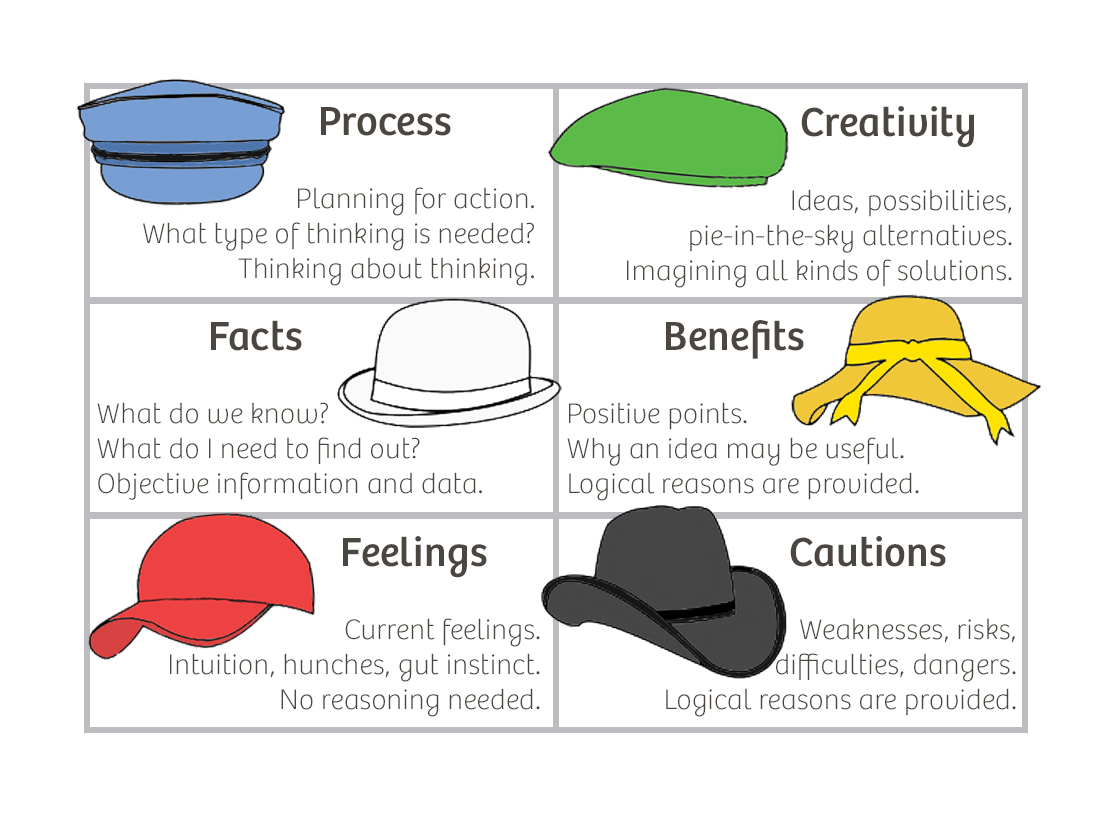
Six Colors, Six Modes, One Room
Each hat represents a distinct mode of thinking. The colors aren’t arbitrary - de Bono chose them as mnemonics that are easier to remember than numbered categories. The real power isn’t in any individual hat. It’s in the discipline of having everyone in the room wear the same one at the same time.
Let me walk through each one, because the details matter more than the summary.
White Hat (Facts and Information)
The White Hat is pure information. Data. Numbers. What do we know? What don’t we know? What information do we need to get?
White Hat thinking is deliberately neutral. No interpretation, no opinion, no spin. If the cart abandonment rate is 34%, that’s a White Hat fact. “That’s terrible” is not - that’s a judgment, and it belongs under a different hat.
This is harder than it sounds. In my classes, I’ll ask a team to spend five minutes in White Hat mode, and within ninety seconds someone says something like “the data clearly shows we need to…” No. That’s analysis. White Hat is just the data. What does the dashboard say? What did the customer survey report? What’s the actual number?
The discipline of separating facts from interpretation is the single most valuable habit this framework builds. Most teams don’t even realize they’re blending the two until you ask them to stop.
White Hat also surfaces information gaps. “We don’t have conversion data for mobile users” is a perfectly valid White Hat statement. Knowing what you don’t know is as useful as knowing what you do.
Red Hat (Emotions and Feelings)
The Red Hat is feelings, intuitions, and gut reactions. No justification required. No data needed. Just - how do you feel about this?
This is the hat that makes analytical people squirm. And that’s exactly why it matters.
De Bono’s insight here is that emotions influence every decision whether you acknowledge them or not. The engineer who “just has concerns about the architecture” might actually be afraid of owning a system they don’t fully understand. The product owner who “wants more data” might actually be nervous about staking their reputation on a risky bet. These feelings are real, they’re valid, and they’re going to drive behavior regardless. Better to surface them deliberately than let them operate underground.
Red Hat has one critical rule: feelings don’t need justification. “I have a bad feeling about this timeline” is a complete Red Hat statement. You don’t have to explain why. You don’t have to defend it. The whole point is to create a space where gut reactions can be voiced without someone immediately asking for your evidence.
In my experience, Red Hat rounds are often the shortest - two or three minutes - and consistently the most revealing. Teams discover that the “disagreement” they’ve been having is actually a shared anxiety that nobody felt safe expressing.
Black Hat (Critical Judgment)
The Black Hat is caution, risk assessment, and critical thinking. What could go wrong? Where are the weaknesses? What are the dangers?
This is the hat most people default to in meetings - which is both the problem and the reason it needs its own dedicated space. When critical thinking is scattered throughout a discussion, it feels like negativity and obstruction. When it’s concentrated in a defined Black Hat round, it feels like due diligence.
Same thinking. Completely different experience.
Black Hat is not about being negative for its own sake. It’s about deliberately stress-testing ideas before committing resources to them. What happens if the API vendor goes down? What if the user research is wrong? What if we’re solving a problem our customers don’t actually have?
Good Black Hat thinking has saved more projects than good ideas have. I’ve watched teams get genuinely excited about a feature, put on the Black Hat for ten minutes, discover a regulatory constraint that would have killed the feature three sprints in, and thank each other for catching it early. That’s the hat doing its job.
Yellow Hat (Positive Judgment)
The Yellow Hat is optimism, benefits, and value. What’s good about this idea? What are the advantages? Why might this work?
This is harder than it sounds - especially for experienced teams. Senior engineers in particular have trained themselves to spot problems. Asking them to spend five minutes on pure upside feels unnatural. (Like asking a cat to appreciate the bath. The instinct goes the other direction.)
But Yellow Hat thinking isn’t naive cheerleading. It’s disciplined optimism - actively looking for value, opportunity, and benefit with the same rigor you’d apply to risk assessment. “If this works, we reduce support tickets by 40%” is a Yellow Hat statement. “This could open up the enterprise market segment” is a Yellow Hat statement.
Yellow Hat also helps teams stay motivated during difficult stretches. When a team is deep in a complex initiative and morale is fading, a structured Yellow Hat round can remind everyone why they’re doing the work in the first place. Not through a pep talk - through a genuine, collective examination of the potential value.
Green Hat (Creativity)
The Green Hat is new ideas, alternatives, and creative thinking. What else could we do? What if we approached this differently? What are the possibilities we haven’t considered?
De Bono was emphatic that creativity isn’t a talent reserved for “creative people.” It’s a mode of thinking that anyone can practice - but most people don’t, because normal meeting dynamics punish it. Suggest a wild idea in a typical meeting and someone will immediately Black Hat it into the ground. Under the Green Hat, Black Hat responses are explicitly off-limits.
The rule is: during Green Hat, no evaluation. Generate ideas. Build on them. Go weird. The assessment happens later, under other hats.
This is where I’ve seen the most dramatic results in coaching. Teams that have been stuck on a problem for weeks will generate three viable alternatives in a fifteen-minute Green Hat round - because the creative thinking was always there. It was just being suppressed by the premature criticism that normal meetings enable.
Green Hat also includes provocations - deliberately absurd ideas designed to shake loose new thinking. “What if we gave the product away for free?” might be ridiculous as a strategy, but it might trigger a conversation about freemium models that nobody had considered. The provocation isn’t the idea. It’s the crowbar that opens the door to the idea.
Blue Hat (Process Control)
The Blue Hat is the meta-hat - the thinking about thinking. It manages the process itself. Which hat should we use next? Are we spending too long on Black Hat? Do we need more White Hat information before we can proceed?
In practice, the facilitator usually wears the Blue Hat - deciding the sequence of hats, managing time, and keeping the group disciplined about staying in the current mode. But Blue Hat thinking can come from anyone: “I think we’re mixing Red Hat and Black Hat right now” is a legitimate Blue Hat observation from any team member.
The Blue Hat typically opens and closes each session. It opens by defining the focus - what are we thinking about, and what sequence of hats will we use? It closes by summarizing what emerged and defining next steps.
De Bono described the Blue Hat as the conductor of the orchestra. The other five hats are the instruments. Without the conductor, you get noise. With the conductor, you get music. (Or at least something closer to music than what most meetings produce.)
What This Changes About Your Coaching
In Retrospectives
Retrospectives are fertile ground for Six Thinking Hats because they already have the problem the framework solves - multiple types of thinking happening simultaneously with no structure to separate them.
Try running a retro with an explicit hat sequence. Start with White Hat: what actually happened this sprint? Just facts. Velocity, incidents, what shipped, what didn’t. Then Red Hat: how does everyone feel about the sprint? No justification needed. Then Yellow Hat: what went well and why? Then Black Hat: what went wrong and what are the risks going forward? Then Green Hat: what could we try differently? Close with Blue Hat: which of these ideas do we commit to?
The difference is immediate. Teams that normally spend forty-five minutes in a muddled conversation where facts, feelings, complaints, and ideas are all tangled together suddenly have a clean, structured flow. Each mode gets its dedicated time. Nothing gets lost.
In Refinement
Refinement sessions benefit enormously from separating Yellow Hat thinking from Black Hat thinking. Most refinement conversations oscillate rapidly between “here’s why this feature is valuable” and “here’s what could go wrong” - and the oscillation exhausts everyone without resolving anything.
Structure it instead. Product owner presents the story (Blue Hat framing). Team asks clarifying questions (White Hat). Team explores the value and benefit (Yellow Hat). Team identifies risks and concerns (Black Hat). Team generates implementation approaches (Green Hat). Then Blue Hat to summarize: do we have enough to move forward, or do we need more information?
This sequence alone can cut your refinement time by a third - not because the team is thinking less, but because they’re not re-treading the same ground in different modes.
In Decision-Making Meetings
When a team needs to make a significant decision - build vs. buy, which architecture to pursue, whether to pivot - the hats provide a structure that prevents the two most common failure modes.
Failure mode one: the HiPPO effect (Highest Paid Person’s Opinion). When the VP speaks first and leads with a strong opinion, everyone else either falls in line or stays quiet. The hats prevent this by requiring everyone to think in the same mode at the same time - including the VP.
Failure mode two: endless debate between two camps. Person A is in Yellow Hat mode (this will work!), Person B is in Black Hat mode (this will fail!), and they argue past each other for an hour. The hats prevent this by sequencing: first we’ll all look at the upside, then we’ll all look at the risks. Same two perspectives, but now they’re cooperative instead of adversarial.
In Innovation Workshops
If you’re facilitating a workshop to generate new ideas - new features, new processes, new ways of working - Green Hat thinking needs protection. And the Six Thinking Hats framework is the best protection mechanism I’ve found.
Run the workshop with an explicit rule: Green Hat first, Black Hat later. Let the team generate ideas without evaluation for a defined period. Write everything down. Encourage building on each other’s ideas. Then - and only then - switch to Yellow Hat to identify the most promising options, followed by Black Hat to stress-test them.
Teams that skip this discipline tend to kill their best ideas in the first five minutes. The person who says “that’ll never work because…” during brainstorming isn’t wrong - they’re just wearing the wrong hat at the wrong time.
What It Looks Like in the Room
Marcus had been coaching a content team at a mid-size publishing company for about four months. The team - two editors, a content strategist, a designer, and a developer - was responsible for the company’s digital magazine platform. They were good at their jobs individually. Their meetings were a disaster.
The pattern was always the same. Someone would bring an idea to the weekly planning session. The content strategist would immediately ask about the data. The senior editor would share why it wouldn’t work based on past experience. The designer would suggest an alternative that nobody acknowledged. The developer would raise technical constraints. The junior editor would stay quiet.
By the end of each meeting, the team had thoroughly discussed every idea and committed to nothing.
Marcus decided to try the hats for their next big decision: whether to redesign their article template to support interactive elements. It was a significant investment - at least six weeks of cross-functional work - and the team had been going back and forth on it for three meetings without resolution.
He opened with Blue Hat. “We’re going to spend forty-five minutes on this decision, and we’re going to think about it one mode at a time. I’ll tell you which hat we’re wearing, and I need everyone to stay in that mode until we switch.”
White Hat first. Five minutes. What do we actually know? The developer pulled up analytics: time-on-page was declining 8% quarter over quarter. The content strategist noted that three competitors had launched interactive article formats in the past year. The senior editor confirmed that their top writers had been asking for embed support. Just facts - no opinions on what the facts meant.
Red Hat next. Three minutes. “How do you feel about this project - gut level, no justification needed.”
The junior editor spoke first - a rarity. “Honestly? Excited. This is the kind of work I came here to do.”
The senior editor surprised everyone: “Nervous. We tried something like this two years ago and it was a mess.”
The developer: “Cautiously optimistic, but a little overwhelmed thinking about the scope.”
The designer: “Frustrated that we keep talking about it and not doing it.”
Marcus watched the room shift. The senior editor’s nervousness - which had been showing up as criticism in every previous meeting - was suddenly just a feeling on the table. Nobody argued with it. Nobody had to.
Yellow Hat. Five minutes. What’s the upside if this works? The team generated a genuinely impressive list. New revenue from sponsored interactive content. Better writer retention. Differentiation from competitors still running static templates. A platform that could support the audio and video content their editorial team had been pitching for months.
Black Hat. Seven minutes. What could go wrong? The senior editor’s concerns finally had a proper home. The previous redesign had failed because they’d tried to do everything at once. The developer added that the current CMS had limitations they hadn’t fully mapped. The content strategist pointed out that their analytics couldn’t currently track interaction-level engagement - they’d be flying partially blind.
Green Hat. Ten minutes. Given everything they’d surfaced, what were the options? The designer - who’d been the quietest person in every previous meeting on this topic - proposed a phased approach: start with just two interactive element types, test them on the ten highest-traffic articles, and measure for eight weeks before expanding. The developer suggested building it as a plugin architecture so they could add element types without touching the core template. The junior editor proposed partnering with two specific writers who’d been most vocal about wanting interactive features - built-in user feedback from day one.
In ten minutes of protected creative thinking, the team generated a better plan than three full meetings of unstructured debate had produced.
Blue Hat to close. Marcus summarized what they’d surfaced across all six modes. The team agreed on the phased approach. The senior editor - the person who’d been the biggest skeptic in every previous meeting - said, “I’m still nervous, but I actually trust this plan. We named the risks and we’re designing around them instead of ignoring them.”
The content strategist said something Marcus wrote down afterward: “We’ve always had all the right thinking in the room. We just never organized it.”
That’s the thing about Six Thinking Hats. It doesn’t make your team smarter. It just stops them from being smart in six different directions at the same time.
Go Deeper
-
de Bono, E. (1985). Six Thinking Hats. Little, Brown and Company. The original book. Short, practical, and still the best introduction. De Bono writes like he’s explaining it to you over coffee - which is exactly the point.
-
de Bono, E. (1970). Lateral Thinking: Creativity Step by Step. Harper & Row. The intellectual foundation behind the hats. If you want to understand why de Bono separated creative thinking from critical thinking, start here.
-
de Bono, E. (1994). Parallel Thinking: From Socratic Thinking to de Bono Thinking. Viking. De Bono’s argument for why Western adversarial debate is a poor tool for group thinking - and what to replace it with. More philosophical than Six Thinking Hats, but essential if you want the deeper “why.”
-
Kahneman, D. (2011). Thinking, Fast and Slow. Farrar, Straus and Giroux. Not directly related, but Kahneman’s work on cognitive biases explains why the hats work - by forcing deliberate, structured thinking in place of the fast, biased defaults our brains prefer.
-
The de Bono Group. debono.com. Official training, certification, and resources for applying de Bono’s methods in organizational settings.